Wanting a hairstyle that flatters your jaw is not vanity — it's exactly what experienced stylists focus on from the moment you sit down. Here's what actually works.
Quick answer: The best hairstyles to hide jowls and double chin add volume above the cheekbones, use soft layers that fall past the jaw, and avoid any cut that ends exactly at the chin or collarbone. The goal is a straightforward optical shift: draw the eye upward and inward toward the cheekbones so the lower jaw and neck recede visually. A layered lob (long bob) ending two to three inches below the jaw is the most consistently flattering choice across hair types — it avoids the chin-shelf effect, adds movement that breaks up the jaw line, and works on straight, wavy, and curly hair alike. Short hair works too, with one condition: the crown must carry height and volume to balance the lower face. Curtain bangs or a side-swept part work with any length to add a diagonal line that shifts visual weight upward and away from the chin — an adjustment that requires no cut change and works immediately.
Jowls and a soft chin are among the most common concerns stylists hear, and the answer is almost always the same: move texture and contrast upward, take weight away from the jaw, and avoid straight horizontal lines at chin level.
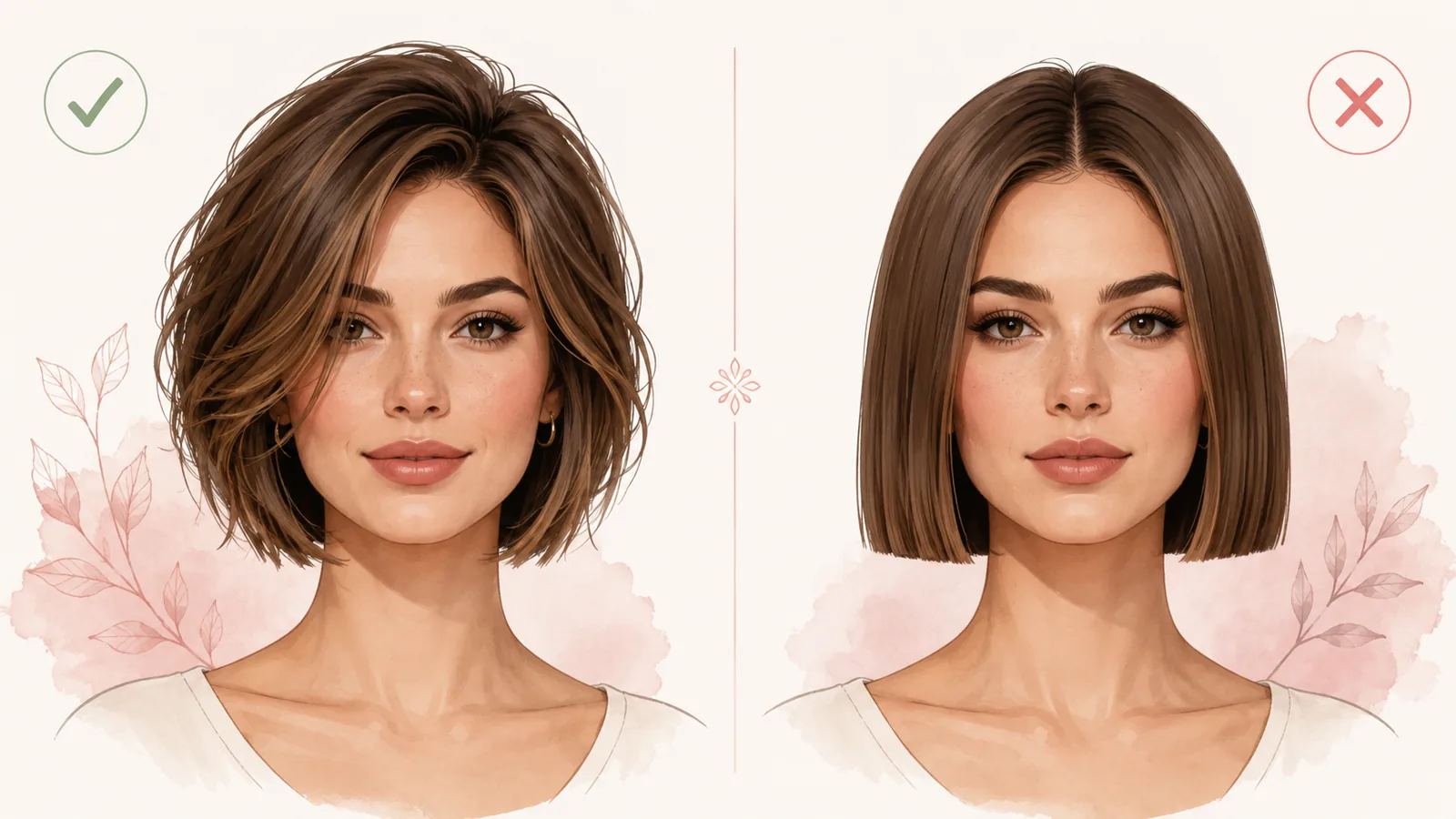
Flattering (left) vs. unflattering (right): soft layers and movement draw the eye up; a blunt line at the jaw draws it straight down to the jowl.
Jump to:
- Quick-reference table by length
- Short hairstyles
- Medium-length hairstyles
- Long hairstyles
- Face-framing techniques
- What to avoid
- Stylist script
- Cheat Sheet
- FAQ
What Hairstyles Are Best for Hiding Jowls and a Double Chin?
| Length | Best option | Why it works |
|---|---|---|
| Short | Textured pixie or pixie bob with crown volume | Keeps weight off the jaw entirely; crown height lengthens the face |
| Medium | Layered lob (2–3 inches below jaw) or soft shag | Layers break up the jaw line; avoids the chin-shelf effect |
| Long | Long layers with soft waves below the shoulder | Vertical movement draws the eye down and past the chin |
| Any | Side-swept or curtain bangs | Diagonal line draws focus up toward the eyes and forehead |
Not sure which of these sits best on your jaw and chin? Preview your face with AI Hair's virtual try-on — upload a photo and see the layered lob, shag, or textured pixie on yourself before you book.
Why Do Some Hairstyles Make Jowls Look Worse?
A haircut makes jowls or a double chin more visible when it places a horizontal line — the cut hem — directly at the jawline. That line acts like an arrow pointing at the jowl. The biggest offenders:
- Blunt one-length bob at chin level — the most common mistake; the cut ends exactly where the jowl sits
- Blunt cut at collarbone length, worn straight — a second horizontal shelf across the neck that emphasizes the jaw-to-shoulder gap
- Flat, center-parted hair with no layers — zero movement means zero distraction; the jaw becomes the only visual anchor
- Short crops with no crown height — leaves the jaw and chin fully exposed with nothing to balance them
What Are the Best Short Hairstyles for Jowls?
Textured pixie with crown lift
A pixie cut short at the back and sides but left longer on top (1.5–2 inches), then texturized and directed upward at the crown, draws the eye straight up. The contrast between close-cropped sides and lifted crown creates vertical height that lengthens the face. Judi Dench, Jamie Lee Curtis, and Halle Berry have each worn variations of this approach — the shared feature is always crown height, not flat sides.
Layered pixie bob
A pixie bob that is longer in front and angled forward with soft interior layers (shorter pieces cut underneath to add volume, leaving the outline unchanged) keeps the jaw framed with movement rather than a hard line. The soft diagonal in front is what separates a flattering pixie bob from one that draws attention downward.
Bob ending below the jaw
A bob that falls one to two inches below the jawline — not at the jaw — lands below the jowl instead of on top of it. Length placement matters more than the style name. Browse the best bob haircuts of 2026 for classic, French-tuck, and curved-hem variations.
What Medium-Length Hairstyles Work for a Double Chin?
The best layered haircuts in medium length consistently solve this problem.
The layered lob
A lob ending two to three inches below the jawline, with face-framing layers starting at the cheekbone, is the most versatile choice. Jennifer Aniston's long-running layered lob — frequently cited by stylists as a go-to reference — ends well past the jaw with pieces that frame the eyes rather than the chin. See the best lob haircuts guide for length and layer options.
The soft shag
A shag haircut uses layers throughout — volume at the crown, face-framing pieces at the cheekbone, feathered ends — to create texture that draws the eye to the midface. The shag is also one of the lowest-maintenance cuts for home styling because the natural movement is built into the shape.
Hair texture note
If your hair is fine or thinning, very dense layers can look stringy rather than soft. Ask for fewer, longer layers (a single interior layer with face-framing pieces rather than many short choppy ones). If your hair is naturally wavy or curly, ask for a dry cut — your stylist cuts with your texture active so they can see exactly where each layer will land once it dries, which prevents layers that spring up and add width at the jaw rather than movement.
Does Long Hair Help Hide Jowls?
Yes — long hair with layers and a slight wave is one of the most forgiving lengths for jowls. Long hairstyles with face-framing layers create continuous vertical lines that lead the eye down rather than stopping at the jaw.
Layers, waves, and the side part
The three variables that make long hair work for jowls: face-framing layers starting at or above the cheekbone, soft waves or body through the length (not pin-straight), and a side or off-center part for diagonal movement. A deep side part is the simplest no-cost change — it creates a diagonal line from the crown across the forehead that immediately shifts visual weight upward and away from the center jaw.
What kills long hair for jowls
Long blunt one-length hair worn completely straight with a center part does the opposite of everything above. It frames the face like a curtain with zero movement, and places the chin at the center of the frame with nothing to redirect the eye.
What Face-Framing Techniques Work Best for Jowls?
The four techniques that most reliably reduce jowl visibility: soft layers starting at the cheekbone, side-swept or curtain bangs, lighter crown color, and root-lifted crown volume.
Soft face-framing layers
Layers cut to fall around the cheekbone — not the chin — shift the visual emphasis to the upper third of the face. Ask for "long face-framing pieces starting at the cheekbone, not the jawline."
Side-swept or curtain bangs
A swooping diagonal from the forehead down to one temple creates a strong upward visual line. Curtain bangs parted in the middle and swept to the sides frame the eyes and forehead rather than the jaw.
Lighter crown color
If you color your hair, keeping the crown slightly lighter (highlights, balayage, or babylights — thin highlights woven close to the root for a subtle brightening effect near the face) draws the eye upward. Heavy, saturated color at the ends concentrates visual weight downward.
Crown volume
Root lift at the crown — from a round brush while blow-drying, velcro rollers, or a root-lift spray — creates height that elongates the face and counterbalances a fuller chin. Ask your stylist to show you their blow-dry technique before you leave so you can replicate the crown lift at home. The same principle appears in the best hairstyles for round faces: crown height is the consistent fix for a wider lower face.
What Hairstyles Should You Avoid If You Have Jowls?
| Avoid | Why |
|---|---|
| Blunt one-length bob at chin | Horizontal line lands directly on the jowl |
| Blunt collarbone-length cut, worn straight | Second horizontal shelf at the neck |
| Slicked-back with center part, no volume | Removes all distraction; jaw becomes the focal point |
| Short clipper cut without crown height | Exposes the full neck with no visual balance |
| Heavy straight-across fringe | Adds visual width rather than height |
Should You Ask for Layers or Keep It Blunt?
For jowls and a double chin, layers outperform blunt cuts in almost every case.
| Layers | Blunt cuts |
|---|---|
| Remove weight from the cut line at the jaw | Concentrate weight at the jaw |
| Create movement — no flat horizontal shelf at the hem | Produce a horizontal line at the hem |
| Air-dry into shape naturally | Require daily flat-ironing to lie smooth |
The exception: a deliberately geometric bob where the graphic line is the design intent, and you are comfortable with it emphasizing the jaw.
How to Ask Your Stylist for This Cut
The phrasing that works:
"I'd like a [lob / layered long bob / shag / layered pixie] with soft face-framing layers starting at the cheekbone — not the jawline. Keep the length at least two inches past my jaw so nothing ends at my chin. I'd like the front pieces to move rather than lie flat, and a slight diagonal or off-center part to draw the eye upward."
If adding color: "Keep the crown and root area a touch lighter than the ends — I want the eye to go up, not down."
You can browse the full styles gallery to compare lengths and shapes, or preview the cut on your own face with AI Hair's try-on and hand the screenshot directly to your stylist.
Cheat Sheet
| DO ask for | AVOID |
|---|---|
| Layers starting at cheekbone | Blunt one-length cut at chin |
| Lob or long style ending below jaw | Collarbone-length blunt cut, worn straight |
| Textured pixie with crown lift | Short crop without crown volume |
| Curtain or side-swept bangs | Straight-across heavy fringe |
| Side or off-center part | Slicked-back center part, no volume |
| Crown volume, root lift | Flat-ironed styles with no movement |
Frequently Asked Questions
What hairstyle hides jowls best?
A layered lob (long bob) ending two to three inches below the jawline, with face-framing layers starting at the cheekbone, works best across hair types and face structures. It avoids placing a cut-line at the jaw, adds movement that breaks up the lower face, and works equally well on straight, wavy, and curly hair. If your hair is fine, ask for a single interior layer with face-framing pieces rather than a heavily layered shag — the result is softer and easier to manage at home.
Does long hair make a double chin look worse?
Not if it has layers and movement. Long hair worn blunt and straight with a center part can emphasize the chin because it frames the face with the chin at the center — any feature there becomes the focal point. Long layered hair with waves and a side part works differently: the layers create diagonal movement, the waves guide the eye along the hair's path rather than stopping at the jaw, and the side part breaks the symmetry that a center part creates. The most common mistake with long hair is wearing it pin-straight with a center part and no layers — all three of those choices simultaneously remove movement, create symmetry that centers the chin, and eliminate the face-framing contrast that pulls focus upward.
Is a bob a good hairstyle for jowls?
It depends entirely on where the bob ends. A blunt bob at chin length is one of the worst options — the horizontal line lands directly on the jowl. A bob one to two inches below the jaw, with a slight interior layer for movement, is a good option. Length placement matters more than the style name. When ordering a bob specifically to soften jowls, ask for: "end the length two inches below my jaw, with a slight interior layer for movement." That single sentence covers the two most important variables — length placement and movement. If your stylist suggests ending at the chin for a cleaner line, push back: chin-length bobs are one of the most common regrets among women who come in specifically wanting to soften their jaw area.
What face shapes tend to have more visible jowls?
Round and square face shapes, which are wider at the lower third, are more likely to have visible jowls because there is more width at the jaw relative to the cheekbones. A fuller chin also appears more prominent in a wider lower face. That said, oval and long face shapes can also develop jaw softening with age since it is related to tissue and skin changes over time — not only to the geometry of the face. Facial plastic surgeons note that jowl prominence increases across all face shapes as the supporting ligaments loosen with age. The styling principles in this guide apply regardless of which shape you have.
Do bangs help with jowls?
Soft bangs, yes. Side-swept bangs or curtain bangs draw attention to the eyes and forehead and create a diagonal line that slims the perceived width of the lower face. A heavy, straight-across fringe does the opposite — it adds visual width and pushes the focal point of the face downward. If you want to add bangs specifically for their framing effect, curtain bangs are the most versatile option: they part naturally and can be worn symmetrically or swept to one side depending on how you style them. Ask for curtain bangs cut at cheekbone length — long enough to brush the sides of the face and frame the upper third without creating a horizontal block across the forehead.
Should hair be worn up or down to hide a double chin?
Down, in most cases. Hair worn up in a high bun or tight ponytail exposes the neck and jawline entirely, removing every element that softens the lower face. The safest approach when you want hair up: ask your stylist to cut long face-framing pieces at the front (three to four inches) that fall forward even when the rest of the hair is tied back. These pieces continue to frame and soften the jawline regardless of what the rest of the hair is doing. The exception for wearing it up: a voluminous, textured top knot with visible crown height and a few loose pieces at the front. The height adds length to the face, and the loose pieces restore the face-framing effect.
Does color affect how jowls look?
Yes, though color works as one part of a strategy rather than a standalone fix. Keeping the top and crown sections lighter (highlights, balayage, or babylights — very fine highlights woven close to the root) draws the eye upward toward the brightest area, which is your crown. Heavy, saturated color concentrated at the ends or around the hairline adds visual weight at the bottom of the frame — the opposite of what you want. For the clearest result, ask for a face-framing balayage that concentrates lighter color in the top layer and in the face-framing pieces around the cheekbone. Avoid highlights applied evenly from root to end, which create no contrast gradient. If your hair is already light, ask instead about a slightly darker toning at the ends to create the same upward-receding effect.
Try Your Hairstyle Before You Commit
The only way to know which of these cuts actually works on your jaw and chin — not on a stock model — is to see it on your own face. AI Hair's virtual try-on lets you preview the layered lob, soft shag, or textured pixie on a photo of yourself in seconds. No commitment, no guesswork. Find the cut that fits, screenshot it, and walk into the salon with a result you have already seen. That certainty alone changes the whole appointment.
Written by the AI Hair editorial team. Styling advice reflects established hair-framing principles used by professional stylists; results vary by individual face structure, hair texture, and density.