Quick answer: Here's exactly how to ask your barber for a drop fade — say "drop fade," then specify three things: the height (low, mid, or high), whether the bottom ends in skin or a short taper, and how much length to keep on top (in inches). Bring one front photo and one side-profile photo, and preview the cut on your own face first so you and your barber start from the same picture.
Saying only "a fade" is how you leave with a cut that doesn't match what you pictured. A drop fade is specific: the fade line curves down behind your ear and follows the round of your skull toward the neckline, instead of holding a level line across the back of your head. This guide covers exactly how to ask your barber for a drop fade — the words to say, the guard numbers, the photos to bring, and how to see the result before the clippers ever touch your hair.
What Is a Drop Fade?
A drop fade is a type of fade haircut where the shortest point "drops" lower behind the ear and curves down to the nape, instead of staying level across the back of the head. That downward arc wraps the natural curve of your skull, which is the whole point of the style.
The arc frames the back of the head, makes the hair on top look fuller by contrast, and creates a cleaner transition into the neckline. It pairs especially well with curly hair, textured crops, and quiffs because the drop follows the direction your hair already falls. The most common mistake is assuming every barber defines "drop fade" the same way — some drop it dramatically, others keep it subtle — which is why the height and guard numbers below matter more than the name alone.
What Do You Say to Your Barber to Get a Drop Fade?
Say this, filling in the brackets:
"I'd like a [low / mid / high] drop fade that goes down to [skin / a #0.5 taper (~1.5 mm)] at the bottom and blends up to about a [#2 or #3] before it reaches the top. Keep the drop behind my ear so it curves toward my neck, with a [natural / blocked] neckline. Leave [2–3 inches] on top."
Three variables decide everything:
- Height — where the fade starts. Low sits just above the ear, mid sits around the temple, high starts near the crown. Higher means more skin and more contrast.
- Bottom finish — skin (bald, maximum contrast) or a taper (a short guard like #0.5, about 1.5 mm — barely-there stubble, softer and lower-maintenance).
- Top length — what stays for styling. Say it in inches, not guards, so there's no confusion between clipper work (the sides) and scissor work (the top).
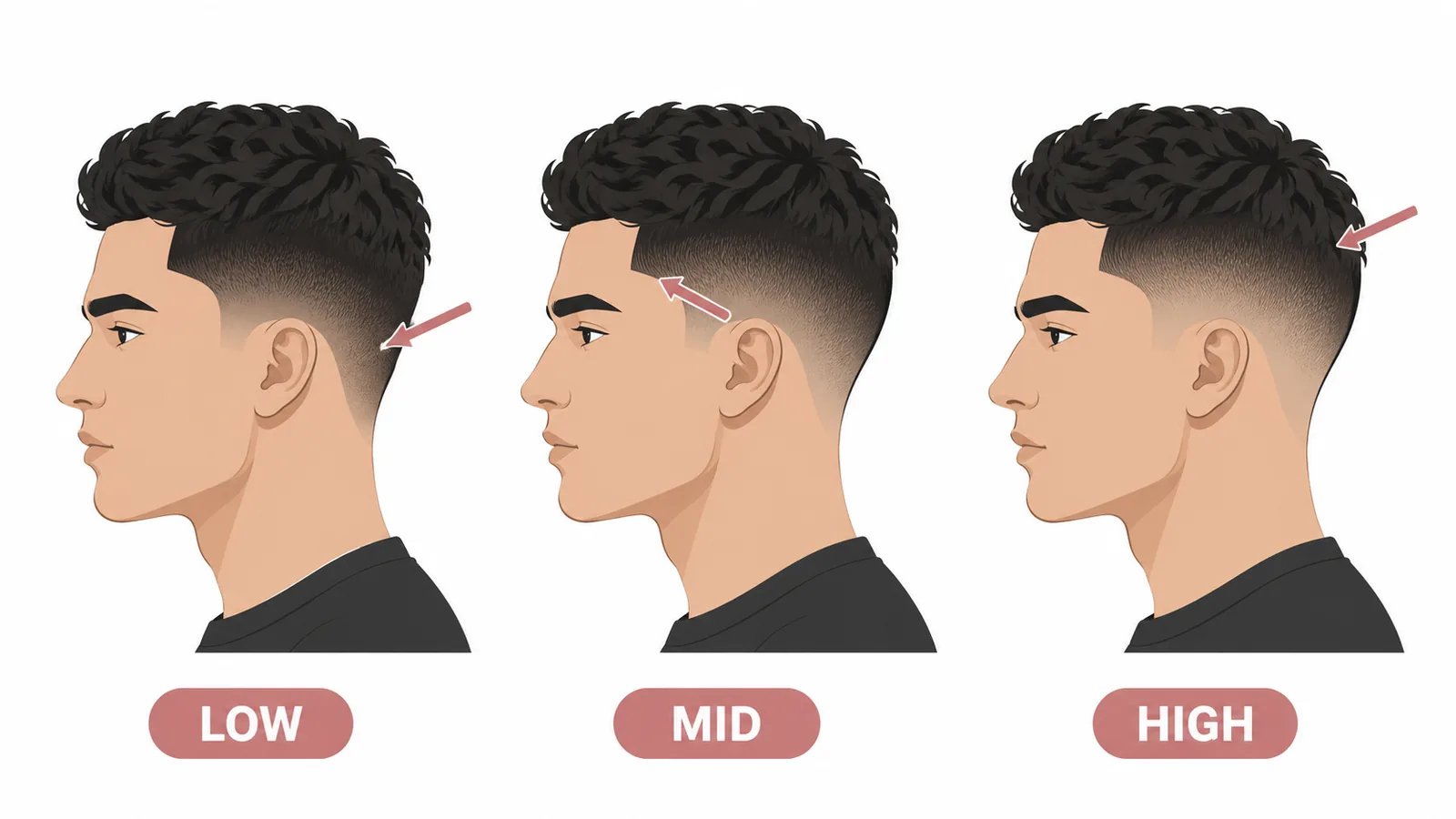
Low, mid, and high drop fade — where each height starts on the side of your head.
And here's the reassurance nobody tells first-timers: barbers appreciate this level of detail — it saves them guesswork. Reading a few specifics off your phone doesn't make you sound like a know-it-all; it makes you an easy client. (For more on this, Art of Manliness has a solid primer on how to talk to your barber.)
What Are the Most Common Drop Fade Mistakes to Avoid?
Most bad drop fades come from the request, not the barber. Avoid these five:
- Saying only "a fade." Always add the type (drop), the height, and the bottom finish.
- Mixing up guards and inches. Use guard numbers for the fade, inches for the top.
- Forgetting the neckline. Rounded (natural) or blocked (squared) changes the whole vibe — state it.
- Bringing no side photo. The drop lives in the profile; a front-only photo hides it.
- Going too high for your hair type. Fine or thinning hair on top pairs better with a low or mid drop for balance.
What Guard Numbers Do You Ask For with a Drop Fade?
Clipper guards run from #0.5 (about 1.5 mm) up. A fade is a gradient between guards, so you're really asking for a starting guard at the bottom and an ending guard where it meets the top. Use this as your reference:
| Drop fade type | Bottom (behind ear) | Blends up to | Length on top |
|---|---|---|---|
| Low drop fade | Skin or #0.5 | #2 | 2–4 inches |
| Mid drop fade | Skin or #1 | #3 | 2–3 inches |
| High drop fade | Skin | #3–#4 | 1.5–3 inches |
| Taper drop (softest) | #1 | #4 | 3–4 inches |
Guard numbers translate to length: #1 is roughly 3 mm, #2 about 6 mm, #3 about 10 mm, #4 about 13 mm. If you're unsure, ask your barber to hold the bottom guard against your skin before they start — a five-second check that prevents a fade that's too high or too aggressive.
What's the Difference Between a Drop Fade and Other Fades?
A drop fade curves the fade line down behind the ear to the nape; a regular fade keeps that line level across the back. A taper is the softest option — it never reaches skin and grows out gradually. A burst fade fans out in a semicircle around the ear only, leaving the back longer, which is why it suits mohawks and mullets rather than an all-around fade. Use this table to pick the right one:
| Fade | Where it sits | Best when you want |
|---|---|---|
| Drop fade | Curves down behind the ear to the nape | A rounded frame that follows the head; volume on top |
| Regular / mid fade | Level line straight across the back | A clean, classic, symmetrical look |
| Taper fade | Short but never skin; gentle at edges | Low maintenance and a subtle, professional finish |
| Burst fade | Fans out in a semicircle around the ear only | Mohawks, mullets, and styles that keep length at the back |
If you want a fade but with the neckline kept longer, you likely want a burst fade, not a drop. If you want the softest, most office-friendly option, ask for a taper. The drop fade is the pick when you want contrast and a shape that hugs the back of your head.
Which Face Shapes Suit a Drop Fade?
A drop fade adds height and narrows the sides, so it flatters most faces — but the height should match your face shape:
- Round faces — go high or mid with length and volume on top; the added height lengthens a round face. (See our guide to hairstyles for round faces.)
- Oval faces — almost any height works; you have the most flexibility.
- Square faces — a mid drop fade softens strong angles without hiding your jawline.
- Long or oblong faces — keep it low and avoid too much height on top, which can lengthen the face further.
Not sure which height suits you? Preview each one on your own photo with AI Hair's virtual try-on — it beats guessing, and it's the fastest way to see "mid vs high" on your actual face.
Ready-to-Copy Scripts by Face Shape
Screenshot the line that matches you and read it straight off your phone:
Round face: "I'd like a mid drop fade, skin at the bottom, blended up to a #3, natural neckline, and keep about 2–3 inches on top for height and volume." (Mid is the safe pick for a round face; ask for high only if you want maximum contrast.)
Oval face: "I'd like a mid drop fade, skin at the bottom, blended up to a #3, natural neckline, with about 2–3 inches on top."
Square face: "I'd like a mid drop fade, a #0.5 at the bottom, blended up to a #3, natural neckline, keeping about 2 inches on top to soften the angles."
Long / oblong face: "I'd like a low drop fade, skin at the bottom, blended up to a #2, natural neckline, and keep about 2 inches on top — not too much height."
Want to compare cuts side by side first? Browse the men's styles in the gallery or read our best men's hairstyles guide for other fade-friendly looks.
What Photos Should You Bring to the Barber?
Bring two photos: one straight-on front view and one side profile showing the drop behind the ear. Barbers read a side shot far more accurately than a verbal description, because the drop is defined by its curve, which only shows in profile.
For the clearest reference, use photos with even, front-facing light (no harsh shadows that hide the fade line), a plain background, and your hair styled the way you normally wear it. Avoid heavily filtered or low-resolution screenshots, which distort the length and blur the transition your barber needs to see.
The single best move is to preview the style on your face before you go, then screenshot it and hand it to your barber — you both look at the same result, which removes almost all of the "that's not what I meant" risk. A side-profile preview of your own head works better than any celebrity photo, because it shows the exact drop and height on your features. That one habit does more than any script to guarantee you walk out happy.
How Often Do You Need to Maintain a Drop Fade?
A drop fade looks sharpest for about two weeks, then the fade lines start to blur as the shortest sections grow in. To keep it crisp:
| Task | Frequency |
|---|---|
| Full re-fade at the barber | Every 2–3 weeks |
| Neckline and edge touch-up | Weekly (barber or trimmer at home) |
| Wash and condition top | As normal for your hair type |
If you can't get in every two weeks, ask for a taper drop (a #1 guard — about 3 mm — at the bottom instead of bald skin) up front. It grows out far more gracefully than a skin fade.
Your Barbershop Cheat Sheet
Take this into the chair:
- Say: "[height] drop fade, [skin / #0.5] at the bottom, up to a [#2–#4], [natural/blocked] neckline, [2–3 inches] on top."
- Guards: low → up to #2 · mid → up to #3 · high → up to #3–#4.
- Neckline: natural (soft) or blocked (sharp).
- Bring: one front photo, one side photo — ideally a try-on preview of your own face.
Frequently Asked Questions
Here are the most common questions people ask before getting a drop fade.
What is the difference between a drop fade and a regular fade?
A regular fade keeps a level, horizontal line across the back of the head. A drop fade curves that line downward behind the ear so it follows the round of your skull toward the neckline, creating more of a frame and more contrast with the hair on top.
Does a drop fade work on curly or natural hair?
Yes. A drop fade works particularly well on curly, coily, and textured hair because the curved fade line follows the same direction the curls fall. A mid or high drop fade with a defined shape-up or twist-out on top is one of the most popular combinations for natural hair. Ask your barber to keep at least 2–3 inches on top for enough curl definition.
Is a drop fade high maintenance?
A skin drop fade needs a re-fade every 2–3 weeks to stay sharp, which makes it moderately demanding. It looks its best for about the first two weeks before the fade lines start to blur. Choosing a taper drop (a short guard at the bottom instead of bald skin) stretches the time between cuts and grows out more smoothly.
What guard number is used for a drop fade?
A drop fade blends multiple guards. It typically starts at skin or a #0.5–#1 behind the ear and blends up to a #2, #3, or #4 before reaching the longer hair on top. The exact numbers depend on whether you want a low, mid, or high fade.
Does a drop fade suit round faces?
Yes. A mid or high drop fade with height on top adds length to a round face and slims the sides, which is why it's one of the more flattering fades for rounder features.
Should I ask for skin or a taper at the bottom of a drop fade?
Choose skin for maximum contrast and the sharpest look, or a taper (a short guard) for a softer finish that is lower maintenance and grows out more gracefully. Tell your barber which one you want before they start.
Does a drop fade work with a beard?
Yes. A drop fade pairs well with a beard when the fade connects cleanly into the beard line. Ask your barber to fade down to skin or a short guard just above where your beard starts, then keep the beard around your #1–#2 length or longer so the two blend into each other. The drop behind your ear stays independent of the beard line.
Try Your Drop Fade Before the Chair
The surest way to walk out happy is to walk in certain. Preview a drop fade — and every other cut you're weighing — on your own photo with AI Hair, screenshot the look you love, and hand it to your barber alongside the script above. Exact words, exact guards, exact result.
Written by the AI Hair editorial team. Guard-size ranges are cross-checked against standard clipper guard specifications; confirm exact lengths with your barber, as guard step-downs vary slightly by clipper brand.